
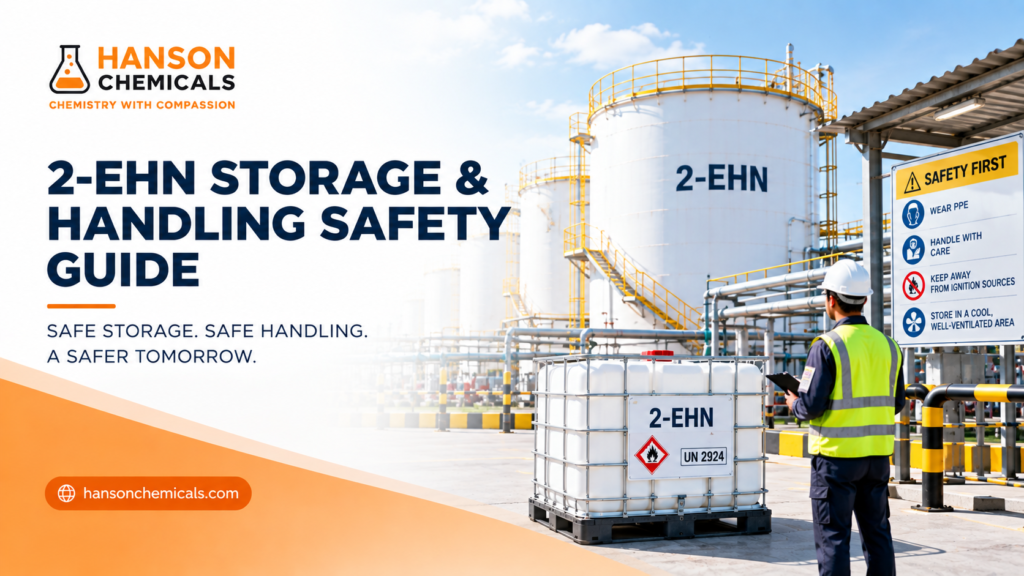
2-Ethylhexyl nitrate (2-EHN) is a volatile, combustible liquid. Handle it carelessly, and you risk worker injuries, environmental violations, and facility shutdowns. Handle it correctly, and your fuel additive operations run safely, compliantly, and efficiently for years.
This guide covers everything facility managers, health & safety professionals, and terminal operators need to know about 2-EHN storage and handling. Whether you’re setting up a new storage system or auditing an existing one, you’ll learn the tank specifications, environmental controls, safety protocols, and regulatory requirements that keep your team safe and your facility compliant.
What Is 2-EHN and Why Storage Matters
2-Ethylhexyl nitrate is a nitrate ester used as a diesel cetane improver and performance additive across fuel and industrial applications. In its pure form, 2-EHN is:
- Highly flammable. Flash point ~85°C; ignition temperature ~280°C. Store it away from heat, sparks, and open flames.
- Volatile. It evaporates in warm conditions or when exposed to air. Poor sealing or ventilation leads to loss of product and air quality issues.
- Potentially explosive. As a nitrate ester, 2-EHN can decompose rapidly if overheated (>130°C). This is why temperature control is non-negotiable.
- Hygroscopic. It absorbs moisture from humid air. Excess water can corrode tanks, alter product chemistry, and affect performance.
- Oxidizing. It can accelerate combustion of other materials. Never store near combustibles, and keep it isolated from incompatible chemicals.
Why does storage matter? Because 2-EHN left in a hot, poorly ventilated drum can:
- Evaporate, reducing effective dosage in your fuel.
- Degrade chemically, affecting cetane response.
- Build pressure (from vapor), creating a safety hazard.
- Attract moisture, introducing water contamination.
- Expose workers to vapor, requiring respiratory protection.
The bottom line: Proper 2-EHN storage isn’t an afterthought—it’s essential to safety, product integrity, and regulatory compliance.
Physical & Chemical Properties
Before designing your storage system, understand 2-EHN’s properties:
| Property | Value | Implication |
|---|---|---|
| Molecular Formula | C₈H₁₇NO₃ | Nitrate ester; oxidizing substance |
| Molecular Weight | 175.23 g/mol | Standard handling for bulk volumes |
| Boiling Point | ~127°C | Evaporates at high temperatures; vapor hazard |
| Flash Point | ~85°C | Classified as flammable liquid (Class IB) |
| Ignition Temperature | ~280°C | Keep storage well below this |
| Vapor Pressure (20°C) | ~0.4 mmHg | Low at room temp; increases significantly above 30°C |
| Density | 1.02–1.04 g/cm³ | Slightly denser than water; sinks if spilled in water |
| Water Solubility | Slightly soluble | Minimizes water contamination risk, but monitor anyway |
| Decomposition Temp | ~130°C | Critical: Never exceed this temperature |
| Stability | Stable at 15–25°C | Requires climate-controlled storage |
Key takeaway: 2-EHN must be stored in a cool, dry, well-ventilated environment. Any deviation (high temp, moisture, poor ventilation) introduces risk.
Storage Tank Requirements
Material Selection
Best for 2-EHN:
- Stainless steel (304 or 316). Excellent corrosion resistance; inert to 2-EHN chemistry. Preferred for long-term storage (5+ years). Higher upfront cost ($8,000–$20,000 for a 20,000-liter tank) but pays for itself in durability and product integrity.
- Epoxy-coated mild steel. Good option if a bare steel tank is already in place. The epoxy lining protects the underlying steel from corrosion. Check the coating condition annually; any cracks or peeling require recoating ($2,000–$5,000).
- High-density polyethylene (HDPE) or polypropylene (PP) totes. Suitable for intermediate storage (drums, 1,000-liter totes). Inert to 2-EHN and resistant to moisture. Lighter weight; easier to handle. Limited to 1–5 year lifespan before replacement (UV degradation, brittleness).
Avoid:
- Bare mild steel. Rusts when exposed to moisture in 2-EHN or humid air. Rust particles contaminate the product and compromise tank integrity.
- Aluminum. Can react with nitrate esters under certain conditions. Not recommended.
- Unlined carbon steel. Same corrosion risk as bare mild steel.
Inspection protocol:
- Stainless steel tanks: Inspect annually for pitting or stress corrosion cracking (SCC). SCC is rare but possible in welded seams under high-chloride environments. If detected, have it professionally assessed.
- Epoxy-coated tanks: Inspect coating annually. Look for cracks, blistering, or edge corrosion. Address immediately.
- Plastic totes: Inspect for cracks, cloudiness (UV degradation), and ground contact (which accelerates degradation). Replace if compromised.
Tank Size & Configuration
Single vs. multiple tanks:
- Single large tank (20,000–25,000 L). Lower cost per liter of storage; easier to manage inventory. Downside: if it fails or requires maintenance, you lose all supply.
- Multiple smaller tanks (5,000 L each). Higher upfront cost; more maintenance burden. Upside: redundancy—if one tank goes offline, you still have supply from the others. Better for critical operations.
Recommendation: For terminals, use 2–3 tanks in parallel. For smaller operations, one tank with a backup drum supply for emergencies.
Tank dimensions:
- Horizontal tanks are standard for space efficiency and easier drainage.
- Vertical tanks save floor space but complicate filling/draining and require more robust support structures.
- Ensure adequate spacing around tanks for inspection, maintenance, and emergency access (minimum 1 meter on all sides).
Outlet & drain design:
- Install a drain valve at the lowest point of the tank for complete emptying.
- Use a ball valve with a lockable handle (to prevent accidental opening).
- Include a ball valve or check valve between the drain outlet and any collection container (to prevent backflow or siphoning).
- Label the valve clearly: “2-EHN Storage Tank Drain.”
Fittings, Connections & Seals
- Inlet: Use a 2–3 inch diameter inlet with a screen filter (to catch particulate during filling). Install a backflow preventer to prevent tank contents from flowing backward into supply lines.
- Outlet: Use a 1–2 inch diameter outlet with a shutoff valve and a strainer. Strainers remove any rust, scale, or debris before dosing 2-EHN into your fuel.
- Vent: Install a desiccant vent (breather) to allow air in/out as tank level changes while preventing moisture ingress. Replace the desiccant cartridge every 6–12 months or after heavy rain.
- Pressure relief: For large tanks, install a low-pressure relief valve set to open at 0.5–1.0 psig to prevent over-pressurization from vapor buildup.
Seals & gaskets:
- Use only gasket materials compatible with 2-EHN: PTFE (Teflon), viton, or nitrile.
- Avoid natural rubber gaskets; 2-EHN can degrade them, leading to leaks.
- Inspect gaskets annually and replace if degraded, brittle, or leaking.
Temperature & Environmental Controls
Optimal Storage Temperature
Target range: 15–25°C (59–77°F)
Why?
- Below 15°C: 2-EHN becomes sluggish, slowing the pumping/dosing process. Not hazardous, but operationally inconvenient.
- 15–25°C: Ideal stability, low vapor pressure, minimal evaporation. Product shelf life exceeds 12 months at this range.
- Above 25°C: Vapor pressure rises. At 35°C, evaporation accelerates visibly; at 45°C+, product degradation begins. Above 130°C, decomposition becomes a serious risk.
Practical considerations:
- Most facility basements or climate-controlled warehouses maintain 18–22°C year-round. That’s perfect.
- For outdoor or non-climate-controlled storage, use shade cloth, reflective covers, or an insulated structure to keep temperature fluctuations moderate.
Monitoring & Control
- Install a thermometer (dial or digital, verified annually) in the tank’s upper third. Check temperature weekly during warmer months.
- In hot climates (>35°C ambient), use passive cooling: Reflective paint on the tank exterior; shade structures; ventilation louvers to allow cooler night air circulation.
- In extreme heat (>40°C), consider active cooling: A thin-walled heat exchanger (cooling jacket) around the tank can maintain temperature within spec, though this adds cost and complexity.
- Alarm system: For critical operations, install a high-temperature alarm that alerts you if tank temperature approaches 30°C. Early warning lets you take action before product degradation accelerates.
Ventilation & Air Handling
Why Ventilation Matters
2-EHN vapor is:
- Harmful by inhalation. Prolonged exposure can cause headaches, dizziness, and respiratory irritation.
- Invisible to the naked eye. You can’t see vapor; you rely on ventilation to keep concentrations below the occupational exposure limit (OEL).
- Denser than air. It settles in low areas (basements, pits, low-lying work zones).
Poor ventilation leads to:
- Worker exposure above OSHA/EPA limits.
- Regulatory violations and fines.
- Potential facility closure.
- Health & safety incidents.
Ventilation Design
Minimum requirement: Local exhaust ventilation (LEV) at the tank filling/draining point. When you open the tank or connect hoses, vapor is vented away from the worker’s breathing zone.
LEV system components:
- Capture hood. A funnel-like device positioned above/around the tank inlet and outlet. Captures vapors at the source.
- Ductwork. Conveys captured vapor to the outside.
- Fan. Typically 500–2,000 CFM (cubic feet per minute), sized to match the hood’s capture area. The fan should run whenever the tank is being filled or drained.
- Discharge outlet. Located outside, away from air intakes (HVAC, windows), pedestrians, and neighboring buildings. Typically 3+ meters above ground or roof level.
General ventilation: Background air movement via louvers, fans, or open windows. Not sufficient on its own for 2-EHN storage, but it helps dilute any vapor that escapes the LEV system.
Maintenance:
- Inspect ductwork quarterly for corrosion, cracks, or blockages.
- Test fan airflow annually. If it’s dropped >10%, clean the filter or have the fan serviced.
- Replace LEV duct filters every 6–12 months depending on usage.
Personal Protective Equipment (PPE)
Required PPE for 2-EHN Handling
| Task | Gloves | Eye Protection | Respiratory | Clothing |
|---|---|---|---|---|
| Filling/draining tank (with LEV) | Nitrile (double-layer) | Safety glasses | None (LEV adequate) | Coveralls or apron |
| Handling drums/totes | Nitrile | Safety glasses | None (if ventilated) | Coveralls; closed shoes |
| Spill cleanup | Nitrile + chemical gloves | Full-face shield | Cartridge mask (if vapor present) | Coveralls; closed shoes |
| Confined space entry | Nitrile + chemical gloves | Full-face shield | SCBA (if vapor >OEL) | Coveralls; boots |
Specific PPE Guidance
Gloves:
- Nitrile gloves are adequate for brief contact (filling transfer lines, checking tank level).
- Chemical-resistant gloves (neoprene or viton-lined) are recommended for prolonged contact (>30 minutes).
- Double-layer gloves provide extra protection.
- Change gloves frequently; dispose of in a chemical waste container (not regular trash).
- Never reuse gloves; they degrade with contact.
Eye protection:
- Safety glasses for routine tasks (drum handling, inspection).
- Full-face shield for spill cleanup or tasks with splash risk.
Respiratory protection:
- With proper LEV: None required for normal operations.
- In poor ventilation or high-vapor areas: Use an air-purifying respirator with organic vapor cartridges (cartridge type: OV or CARTridges labeled for organic vapors).
- For confined spaces or unknown vapor concentration: Use a supplied-air respirator (SAR) or self-contained breathing apparatus (SCBA). Always get atmospheric monitoring before entering.
Clothing:
- Coveralls: Standard cotton/polyester blend is fine; they protect skin and allow easy removal if contamination occurs.
- Closed-toe shoes: Closed shoes prevent spills from running inside; neoprene or chemical-resistant shoe covers add protection.
- Never wear: Loose clothing, open-toe shoes, jewelry that can catch on equipment.
First Aid & Skin Contact
If 2-EHN contacts skin:
- Remove contaminated clothing immediately (but don’t cause injuries doing so).
- Rinse skin with water for at least 15 minutes. Use copious amounts.
- Wash with soap and water for an additional 5–10 minutes.
- Seek medical attention if irritation persists or large area is affected.
Never use: Organic solvents or harsh scrubbing (which can drive 2-EHN deeper into skin). Water and mild soap are sufficient.
Spill Prevention & Containment
Spill Prevention (Primary Strategy)
- Double-wall tanks or secondary containment below and around primary tanks. Containment volume should be ≥110% of the largest single tank capacity. So a 20,000-liter tank requires 22,000 liters of containment.
- Careful transfer procedures. Use dripless couplers, hose racks, and absorbent mats under connection points. Inspect hoses before each use.
- Pressure relief. Tanks should have a relief valve to prevent over-pressurization and rupture.
- Regular inspections. Check tanks, hoses, and fittings monthly for leaks, corrosion, or cracks.
Containment Design
Secondary containment can be:
- Concrete floor with bunded walls. Most robust; expensive to retrofit into an existing facility.
- Steel or plastic containment tank (tray-like structure) beneath the primary tank.
- Absorbent boom or pads placed directly under the tank and around connection points.
Drainage:
- Containment should have a drain valve so collected spills can be pumped out and properly disposed of (not poured down drains or into soil).
- Never use the drain unless a waste container is directly connected. Accidental spills into groundwater carry environmental liability.
Emergency Response Procedures
Immediate Response to Spill
Small spill (<10 liters):
- Evacuate non-essential personnel from the area.
- Turn off sources of ignition (smoking, hot work, spark-generating equipment).
- Ventilate the area (open windows, activate LEV system).
- Don appropriate PPE (double nitrile gloves, safety glasses, respiratory protection if vapor is thick).
- Absorb the spill using absorbent pads, sand, or commercial absorbent granules. Sweep into a container.
- Place absorbent materials in a chemical waste bin (labeled for 2-EHN waste).
- Inspect the area for secondary contamination (cracks in floor, nearby grates). If soil is contaminated, it may require professional remediation.
- Document the spill (date, time, volume, cause, response taken, notifications made).
Large spill (>10 liters):
- Evacuate the area immediately. Establish a 50-meter exclusion zone.
- Call emergency services (911, fire department, hazmat team).
- Contact your environmental agency (EPA, state environmental protection agency, or local equivalent).
- Do not attempt to clean up yourself. Let professionals handle it.
- Preserve the scene for investigation.
- Notify your insurance company and corporate risk management.
- Retain cleanup contractor records for regulatory filing.
Fire involving 2-EHN:
- 2-EHN is combustible; use water, foam, or dry powder extinguishers—not carbon dioxide (CO₂).
- Evacuate immediately and call the fire department.
- Do not re-enter the area.
EPA & OSHA Compliance
Regulatory Landscape
OSHA (Occupational Safety & Health Administration):
- Hazard Communication Standard (HCS 2012). You must provide workers with access to Safety Data Sheets (SDSs) and hazard label information.
- Occupational Exposure Limits (OEL). While OSHA hasn’t set a formal PEL (Permissible Exposure Limit) for 2-EHN, the ACGIH (American Conference of Government Industrial Hygienists) recommends a Threshold Limit Value (TLV) of 0.5 mg/m³ as an 8-hour TWA (time-weighted average). Your facility should meet or exceed this.
- Storage & handling. OSHA requires safe storage of flammable liquids per 29 CFR 1910.106 (Flammable Liquids).
EPA (Environmental Protection Agency):
- RCRA (Resource Conservation and Recovery Act). If 2-EHN spills exceed reportable quantities (RQ), notification is required.
- Spill reporting. Spills >1 pound (or an RQ set by EPA for this specific chemical) must be reported to the National Response Center (NRC): 1-800-424-8802.
- CERCLA (Comprehensive Environmental Response, Compensation & Liability Act). Large spills can trigger environmental liability and cleanup obligations.
State regulations:
- Many states have stricter rules than EPA/OSHA. Check your state’s environmental and occupational safety agencies for specific requirements.
Compliance Checklist
- SDS on file. Printed or digital copy accessible to all workers within 2 minutes.
- Hazard labels on all containers. GHS (Globally Harmonized System) labels with pictograms, signal words, hazard statements.
- Emergency contact list posted. Including poison control (1-800-222-1222), CHEMTREC (1-800-424-9300), fire/hazmat.
- Spill response kit available. Absorbent pads, sand, waste containers, PPE.
- LEV system functional. Tested and maintained; documentation on file.
- Temperature monitoring. Weekly checks; recorded log.
- Containment adequate. ≥110% of largest tank; drain valve accessible and working.
- Worker training current. All personnel handling 2-EHN trained on SDS, spill response, emergency procedures. Refresher training annually.
- Inspection records. Monthly tank checks, quarterly ventilation inspections, annual SCC or coating inspections.
- Incident reporting. Log for spills, near-misses, health issues.
Common Storage Mistakes
Mistake 1: Storing 2-EHN in bare steel drums or tanks. Rust forms; contamination compromises product and tank integrity.
Solution: Use stainless steel, epoxy-coated, or plastic. If switching from bare steel, decontaminate the new vessel thoroughly before transferring 2-EHN.
Mistake 2: No temperature control. You store 2-EHN in an uninsulated shed. Summer heat causes evaporation and degradation.
Solution: Use a climate-controlled facility (basement, climate-controlled warehouse, or insulated shed with passive cooling). Monitor temperature weekly.
Mistake 3: Poor ventilation at the filling point. Workers are exposed to vapor; OSHA violations.
Solution: Install local exhaust ventilation (LEV) with a capture hood and ducting to outside. Test it annually.
Mistake 4: No secondary containment. A tank rupture spills 20,000 liters directly into soil. Cleanup cost: $50,000–$200,000+.
Solution: Secondary containment (concrete bund, steel tray, or absorbent boom) captures 110% of tank volume.
Mistake 5: Storing 2-EHN near incompatible materials. You keep 2-EHN next to combustible materials or reactive chemicals. Fire or explosion risk.
Solution: Isolate 2-EHN storage. Keep combustibles (wood, cardboard, paint, gasoline) at least 10 meters away. Segregate from acids, bases, and strong oxidizers.
Mistake 6: No SDS or hazard labels. A new worker handles 2-EHN without knowing it’s flammable or a respiratory irritant. Incident occurs.
Solution: Post SDS at the storage area and in the worker safety binder. Label all containers with GHS hazard labels.
Mistake 7: Infrequent inspections. A tank develops a slow leak. It goes unnoticed for weeks; contamination spreads to surrounding soil.
Solution: Inspect tanks and containment monthly. Document findings. Address leaks immediately.
Mistake 8: Desiccant vent not replaced. The desiccant cartridge in the tank’s vent absorbs water until it’s saturated. New moisture enters the tank, contaminating the product.
Solution: Replace desiccant vent cartridges every 6 months or after heavy rain. Use a color-changing cartridge so saturation is visible.
Storage Best Practices Checklist
Print and post this checklist near your 2-EHN storage area. Review and initial weekly.
Daily:
Visual inspection of tank for leaks, damage, or corrosion.
Check containment tray/bund for standing liquid (sign of a leak).
Ensure LEV system is functional (listen for fan; check for air movement).
Weekly:
Record tank temperature. Flag if >28°C or <10°C.
Inspect hoses and fittings for cracks, corrosion, or weeping.
Check desiccant vent cartridge. If saturated (color faded), note for replacement.
Monthly:
Full tank exterior inspection (photo documentation recommended).
Check drain valve—open/close to ensure it’s not stuck.
Inspect secondary containment for debris, cracks, or blockages.
Review and file inspection records.
Quarterly:
LEV ductwork inspection. Look for corrosion, dents, blockages.
Test LEV fan airflow. If <10% drop from baseline, system is OK; if >10%, have fan serviced.
Review incident log. Address any near-misses or spills.
Annually:
Replace desiccant vent cartridge (or more frequently if climate is humid).
For stainless steel tanks: Have a qualified technician inspect for SCC in welded seams.
For epoxy-coated tanks: Inspect coating condition. If cracks are visible, plan recoating.
Worker refresher training on SDS, spill response, and emergency procedures.
Test temperature alarm system (if installed).
Calibrate thermometer against a certified standard.
Every 2–3 years:
Professional pressure test of tank (hydrostatic or pneumatic).
Internal tank inspection (if feasible; some tanks require tank-cleaning services before entry).
Certify secondary containment capacity.
FAQ
Q: Can I store 2-EHN in a plastic tank? A: Yes, HDPE or polypropylene totes are compatible with 2-EHN. Suitable for intermediate storage (1–5 years). Replace if UV-degraded, cracked, or brittle. Not ideal for large, permanent installations (tank trucks, 20,000+ L), where stainless steel is preferred.
Q: What temperature is too hot for 2-EHN storage? A: Avoid sustained temperatures >30°C. Beyond that, vapor pressure rises and evaporation accelerates. Above 130°C, decomposition becomes significant. Use cooling methods (shade, ventilation, heat exchangers) to keep storage ≤25°C.
Q: How often should I test my 2-EHN for water contamination? A: Quarterly for critical operations; every 6 months for routine operations. Water content should remain <500 ppm. If water rises above 1,000 ppm, the product may have absorbed moisture during storage or delivery. Contact your supplier for a replacement batch.
Q: Can I store 2-EHN with other fuel additives? A: No. Store 2-EHN separately from other additives, fuels, and incompatible chemicals. Cross-contamination can alter product chemistry, reduce efficacy, and create safety risks (e.g., heat of reaction if reactive chemicals mix).
Q: Is 2-EHN storage regulated by Fire Code? A: Yes. Local fire codes often classify 2-EHN as a Class IB flammable liquid (flash point <73°F / <23°C). Consult your local Fire Marshal’s office for specific storage limits, ventilation requirements, and permit needs.
Q: What’s the shelf life of 2-EHN in storage? A: 12–24 months under ideal conditions (15–25°C, dry, well-sealed container). Beyond 2 years, stability cannot be guaranteed. Request a fresh batch or have the old batch tested for purity before use.
Q: Can I use dry chemical or CO₂ fire extinguishers on a 2-EHN fire? A: No. Use water, aqueous film-forming foam (AFFF), or dry powder (ABC-rated) extinguishers. CO₂ is ineffective on nitrate-ester fires. Always evacuate and call the fire department for large fires; do not fight them yourself.
Q: Do I need to report small 2-EHN spills? A: Small spills (<1 pound or below your state’s RQ) don’t require EPA notification, but you should document them internally and ensure proper cleanup. Check your state environmental agency for specific reporting thresholds. When in doubt, report.
Q: What’s the best containment material—concrete, steel, or plastic? A: Concrete bunds are most durable and suited for outdoor installations. Steel trays work for indoor, climate-controlled areas. Plastic containment is portable but less durable. Choose based on your facility layout, climate, and expected usage.
Q: Can 2-EHN storage be placed underground? A: Underground tanks are possible but complex. They require secondary containment (double-wall or monitoring system), cathodic protection (if steel), and regular inspections for leaks. Above-ground or indoor storage is simpler and allows easier inspection. Consult a storage engineering firm if underground storage is necessary.
Conclusion: Storing 2-EHN Safely Protects Your Team & Facility
Safe 2-EHN storage isn’t complicated—it’s methodical. Keep it cool (15–25°C), dry (desiccant vent), well-ventilated (LEV at filling points), and isolated (secondary containment, distance from incompatibles). Inspect regularly. Train your team. Document everything.
When you do this, your fuel additive storage becomes a model of safety and compliance. Your workers are protected. Your facility is protected. Your products maintain their integrity.